CUSTOMER EXPERIENCE ENABLEMENT
Building Frontline Communication Capability
Developing the interpersonal skills that transform difficult customer interactions into opportunities for resolution, trust, and operational efficiency.
Behavioral Learning
Instructional Design
Performance Enablement
THE EXECUTIVE SNAPSHOT
Targeted learning. Measurable performance.
To address communication and performance gaps within the Customer Service department of a national franchise-based organization, I designed and implemented a progressive behavioral learning program focused on navigating complex customer interactions.
The program combined intentionally scaffolded learning, authentic practice, and reinforcement activities to strengthen frontline communication capabilities and support measurable operational improvement.
6
Core Competencies
Progressive behavioral development
4.8/5
Customer Satisfaction
Increased from 4.7
60.5%
Escalation Reduction
30-day pre/post comparison
Company identifiers are proprietary information and have been omitted to maintain confidentiality.
THE BUSINESS CHALLENGE
When communication gaps become performance gaps.
Navigating difficult customer interactions requires more than product knowledge and procedural expertise. Frontline employees must also be equipped to manage emotions, uncover underlying concerns, communicate unfavorable outcomes, and confidently guide customers toward resolution.
Communication Consistency
Variability in communication approaches can lead to inconsistent customer experiences.

Difficult interactions can result in avoidable escalations when employees lack effective resolution strategies.
Leadership Dependency

Ineffective probing and communication can prolong interactions and complicate resolution.
Operational Efficiency

Develop a consistent set of frontline communication competencies that empower employees to navigate challenging interactions while balancing customer satisfaction and operational effectiveness.
The Objective
THE LEARNING ARCHITECTURE
From foundational skills to confident execution.
Each competency builds upon previously acquired skills, progressively equipping employees to navigate more complex customer interactions.
01 / ESTABLISH THE FOUNDATION
Active Listening & Empathy
Recognize customer needs, acknowledge concerns, and establish trust.
02 / MANAGE EMOTIONS
De-escalation Techniques
Apply foundational communication skills to emotionally charged situations.
03 / UNCOVER THE ISSUE
Probing & Troubleshooting
Ask intentional questions to identify underlying problems and guide resolution.
04 / COMMUNICATE WITH CONFIDENCE
Positioning the No
Deliver unfavorable outcomes while maintaining professionalism and customer trust.
05 / ADAPT & APPLY
Navigating Complexity
Apply communication and problem-solving strategies to unfamiliar situations.
06 / REFINE PERFORMANCE
Communication Efficiency
Balance empathy, clarity, and resolution with operational efficiency.
Consistent, confident, and effective frontline communication.
THE LEARNING EXPERIENCE DESIGN
Designed for application, no memorization.
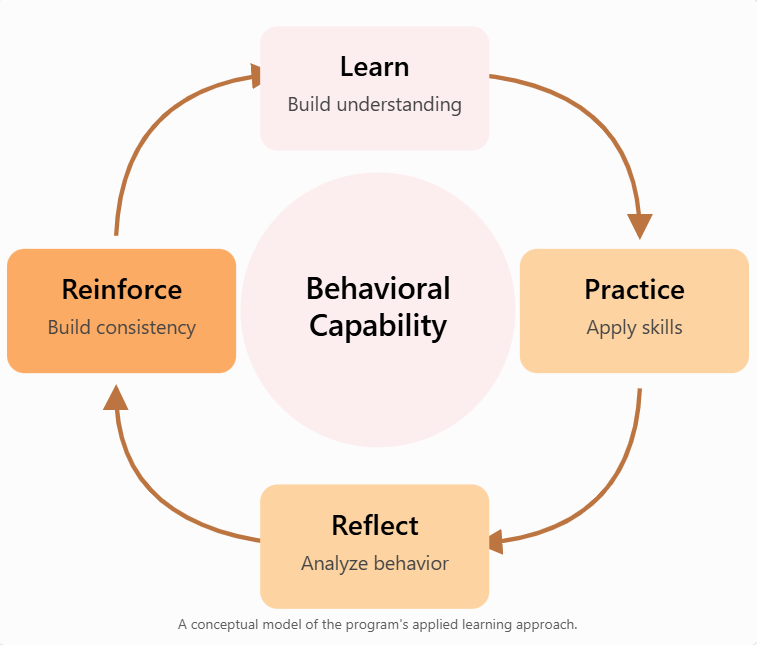
Communication skills require opportunities to practice, reflect, and refine. The program integrates multiple instructional methodologies to bridge the gap between understanding a concept and applying it in a live customer interaction.
Facilitated Learning
Interactive instruction introduces communication techniques, practical frameworks, and examples of effective application.

Real Call Analysis
Authentic customer interactions connect learning concepts to observable workplace behaviors.

Scenario-Based Role Play
Realistic customer scenarios provide a structured environment for practicing challenging conversations.
Learning Reinforcement
Follow-up activities reinforce skill application and promote consistency beyond the training session.
Learning Application Cycle
THE MEASUREMENT STRATEGY
Success defined beyond the classroom.
Evaluation was incorporated into the training plan to connect capability development with observable operational performance.
01
Establish

Capture a 30-day pre-training performance baseline.
02

Develop
Deliver the progressive communication training series.
03
Evaluate

Compare operational indicators over the 30-day post-training period.
Evaluation Focus
Quality Assurance
Customer Satisfaction
Leadership Escalations
Pre-Established Framework
THE BUSINESS IMPACT
Stronger communication. Better customer outcomes.
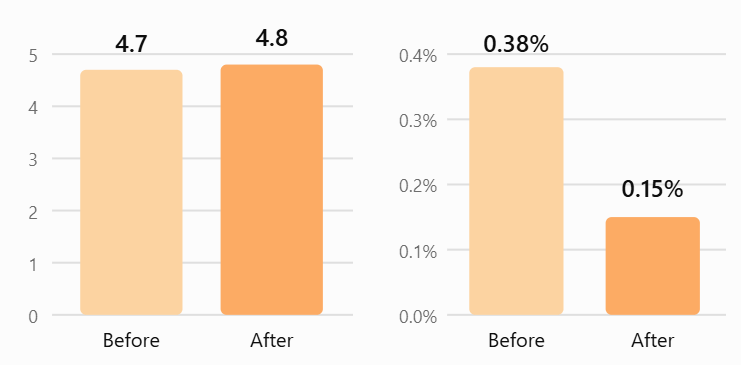
Customer Satisfaction
Leadership Escalations
+0.1
Point improvement
Equivalent 3—day pre and post-training measurement periods

Customer Experience
Higher customer satisfaction scores.

Frontline Resolution
Fewer interactions requiring leadership escalation.
-60.5%
Relative reduction

Operational Capacity
Potential to reduce leadership time spend resolving escalated customer concerns.
SELECTED WORK SAMPLES
Behind the learning experience.
Explore selected resources that illustrate the instructional design, program planning, and performance evaluation strategies behind this initiative.

Sample Training Deck
Illustrates interactive instruction, communication frameworks, and applied learning activities.
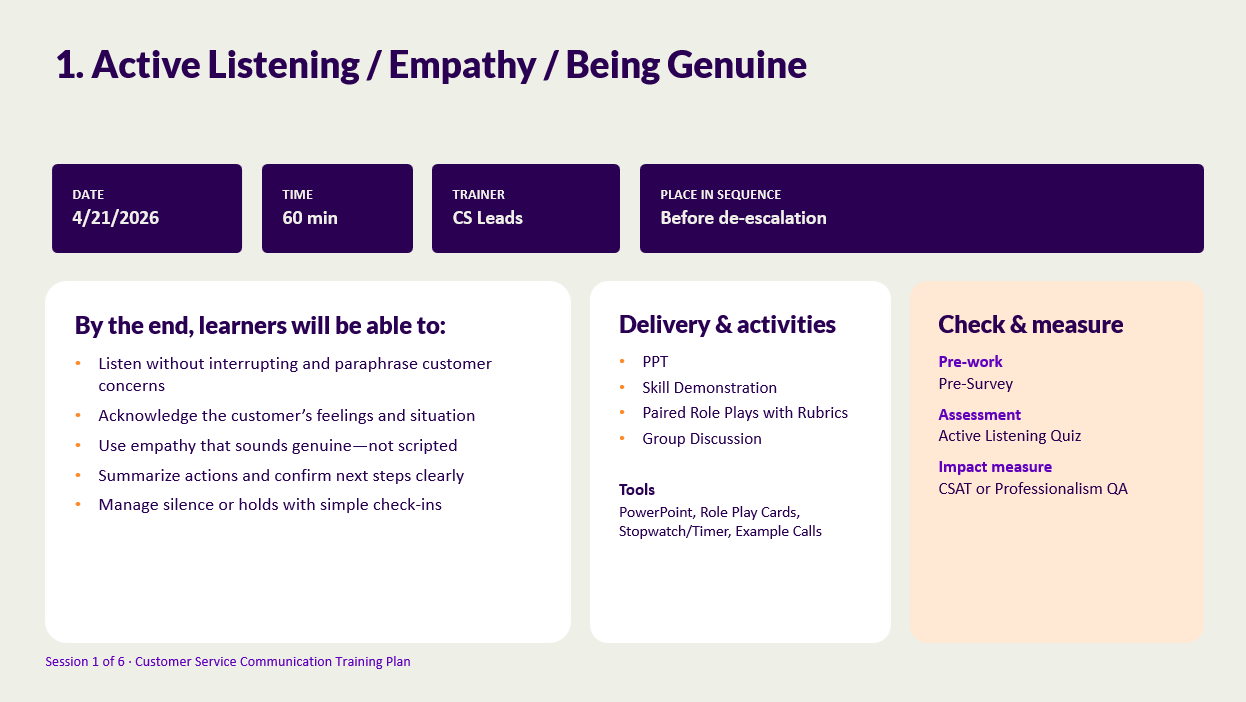
Program Training Plan
Demonstrates curriculum sequencing, intentional scaffolding, and program architecture.
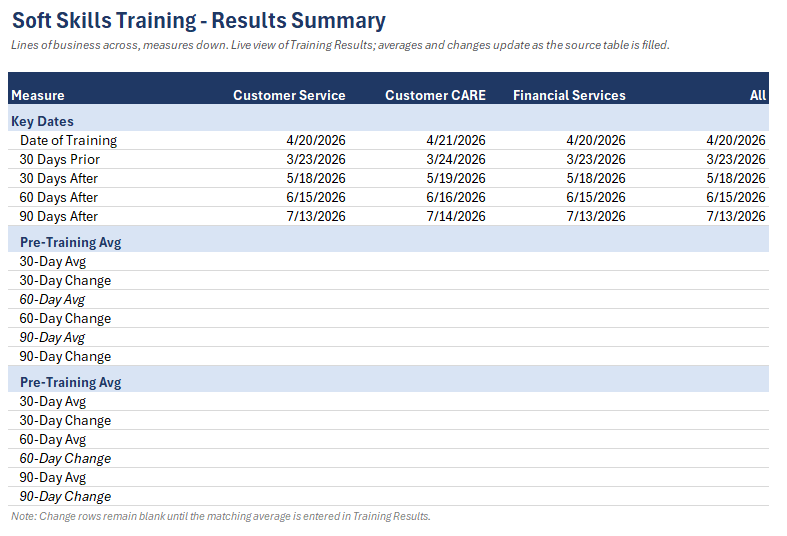
Performance Tracker
Showcases the integration of learning evaluation and operational performance measurement.
THE DESIGN PHILOSOPHY
Soft skills.
Tangible business value.
Effective communication is not an abstract competency. It is a measurable business capability that can be intentionally developed through progressive learning, authentic practice, and performance-based evaluation.
The ultimate measure of effective learning is not what employees know, but what they are equipped to do differently.